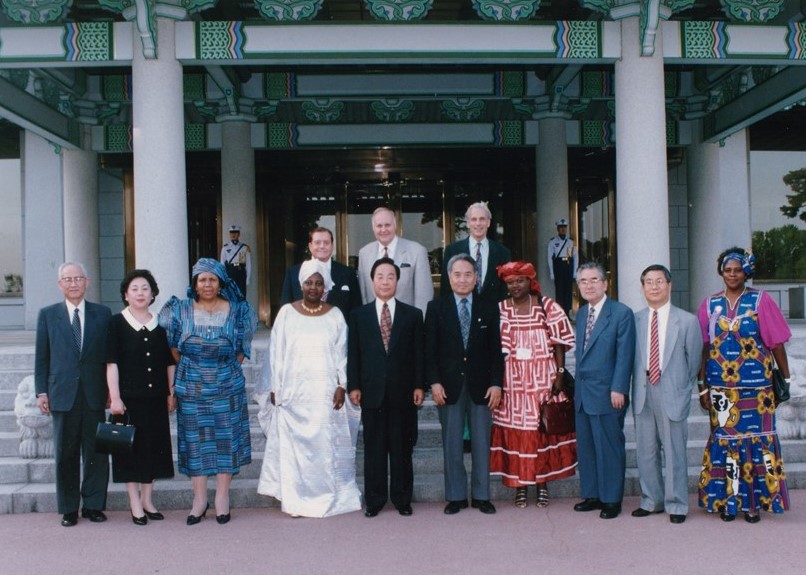
Introduction
Globalization provides us with opportunities to evangelize and disciple multi-cultural people who live in our community. We can share salvation openly with people who are from restricted countries. Church leaders are being challenged to minister to their diverse communities and are shifting their leadership styles from mono-cultural to multi-cultural.
A Bi-Cultural Minister—Rev. Thomas Wang
Rev. Thomas Wang was born in Beijing, China, into a third-generation Christian family. He attended an American school in Beijing from grade school to high school. Right after his seminary graduation in the U.S., Wang went to Europe as an itinerant evangelist during the summer. He has lived in America for over 50 years. His over 30 years of multi-cultural leadership experiences began during his service at the Chinese Coordination Center for World Evangelization, and later at the Lausanne Committee for World Evangelization, the AD2000 and Beyond Movement, and the Back to Jerusalem Movement.
Wang is a man with a big heart, recognized for his gift of leadership. He is a visionary and a catalyst. God has laid a desire upon his heart for the spiritual revival of his second homeland America. Wang initiated prayer meetings and participated with multi-ethnic churches in the Bay Area to call America to repent and return to God since 2004.
Cultural Awareness
Wang learned cultural awareness through his mother’s teachings and the way he grew up. When he came to the U.S. for seminary, he recognized large cultural differences during his visit to an American friend’s family. He has learned that he needs to identify and understand his own culture first, and then he will be able to appreciate and overcome cultural differences.
Multi-Cultural Leadership
The blessing Wang has received through his multi-cultural services is the sense of fulfillment; a fulfillment of thanking God for giving him the privilege, gift, and opportunity, particularly for his work among western leaders to accomplish the Second Lausanne Congress in Manila as the International Director. There were a few western leaders who looked down on non-westerners while Wang worked with them. He needed to endure by God’s grace. After working with these western leaders for a few years, they came to realize that there was an Asian who could do the work. When other leaders had confidence in his integrity, it highly benefited his leadership.
Multi-Cultural Cooperation
Wang thinks unity and diversity exist at the same time. Cultures are not entirely collective or individualistic, but rather exist on a spectrum. Team work as a group is also important to individualism as an individual is to collectivism. Holding a meeting is to gain the collective opinions, and opinions are from individuals in the group. Christians need to have unity for we have diversified gifts as a body of Christ. Understanding each other to establish unity in diversity will result in triumph for the Kingdom. Leaders should not be overwhelmed or hindered by cultural differences.
Conflict Resolution
For Wang, conflict is the biggest challenge in a multi-cultural situation. As an experienced leader, Wang may know the most efficient way to complete a task, but others might have a different way than his. In these situations, he gives up his own approach in favor of others to avoid disrespecting anyone’s feelings, even if the end result does not meet his expectations. To resolve disagreement, he often reaches out to other leaders personally, instead of having a confrontation as a group. He has had to defuse situations where someone insists upon an idea and refuses to back down in order to save face. A leader should maintain a stance that is neutral and Biblical, and do some personal work before meetings to reduce possible conflict.
Wang emphasizes that a leader must maintain a heart of love, patience, and tolerance, without compromising Biblical truth. Leaders need to be willing to sacrifice their personal agendas and accommodate others. If he could re-visit any previous conflicts in his life, he would pray more for God’s inspiration and guidance, and invite more personal sharing with other leaders to build the relationship.
Trust, Empowerment, and Vision
Wang’s leadership experiences have shown him that relationship building is not for Asians only, but applies to western leaders as well. He builds relationships by preparing committee members’ hearts before the meeting to let them know some possible problems, and to inform and encourage them ahead of time. He also spends time with the second and third level leaders, because when he greatly increases understanding friction decreased. Personal encounters, discussion, and fellowship are very important for trust and empowerment. He uses the Apostle Paul’s teachings on circumcision as an example for leaders to walk the extra mile for cultural differences. A big man is a man with a big heart and does not focus on details. But if the detail is about the Biblical truth, it is important then.
As a visionary, the prophetic gift is the one Wang appreciates the most. While most ordinary people see things on a surface level, the gift of prophecy allows him to see below the surface. A person with a vision looks further and deeper. Cultural values and assumptions are diversified, but our faith cannot be diversified. If Wang is certain the guidance is received from God, he will not change his vision in spite of human opposition. Leaders need to focus on the main thing meaning a Kingdom mindset, God’s will, vision, mission, strategy and so on.
Reflection
Wang is a Kingdom-minded servant with Kingdom values. He resolves cultural conflicts with Biblical principles and keeps his focus on the main thing. He grasps cultural awareness from understanding his own culture first, and is a person of prayer, and of integrity. He is a leader who is willing to walk the extra mile, and sees others as a family and the body of Christ.
Every Christian brings their own cultural values and expectations to their church. The different assumptions about structure, accountability, and working relationships can cause conflict even when Christians try to work together toward a mutual goal.[1] Awareness and understanding of different cultures can be learned. Without trust, no leaders will have followers. A multi-cultural leader must understand that his leadership is a commitment and responsibility to the community.[2]
Leaders must keep learning, their experience without reflection is not necessarily learning.[3] Food and dress are external cultural practices. The internal cultural values are assumed, hidden, subtle and unspoken which create tensions and difficulties in multi-cultural leadership.[4] To understand cultural values helps us to have a more positive attitude toward people who misunderstand us.[5]
Every multi-cultural leader needs to give continued attention to their vision and work which are vital to Kingdom work.[6] Focusing on the vision allows leaders to develop strategies that can meet the needs of their current situation.[7] Besides having solid Biblical understanding, a leader must know how to apply his understanding to the cultural situation.[8] He sees the world from God’s perspective as a theo-centric collectivism[9], and blurs the differentiation between individualism and collectivism.[10] The more a leader becomes like Christ, the more deeply he is rooted in the richness of the global family of God. When approaching others, a global leader is open and flexible, able to handle situations and people dissimilar from his background, and willing to reexamine and adapt personal attitudes and perceptions.[11]
Conclusion
For multi-ethnic community outreach, love and care speak louder than words. We need to begin by loving God first and then love the people around us with a willingness to learn and adapt. True community outreach is about love, servanthood, and humility. Global secular corporations hold trainings for their leaders to become multi-cultural. The Church needs to see the importance of equipping her leaders and followers with intercultural skills to have authentic fellowship, and be the light and salt in her multi-ethnic community and the world.
BIBLIOGRAPHY
Bordas, Juana. Salsa, Soul, and Spirit: Leadership for a Multicultural Age. San Francisco, CA: Berrett-Koehler Publishers, Inc., 2007.
Lingenfelter, Sherwood G. Leading Cross-Culturally: Covenant Relationships for Effective Christian Leadership. Grand Rapids, MI: Baker Academic, 2008.
Plueddemann, James E. Leading Across Cultures: Effective Ministry and Mission in the Global Church. Downers Grove, IL: IVP Academic, 2009.
[1] Sherwood G. Lingenfelter, Leading Cross-Culturally: Covenant Relationships for Effective Christian Leadership (Grand Rapids, MI: Baker Academic, 2008), 20-1.
[2] Juana Bordas, Salsa, Soul, and Spirit: Leadership for a Multicultural Age (San Francisco, CA: Berrett-Koehler Publishers, Inc., 2007), 154.
[3] James E. Plueddemann, Leading Across Cultures: Effective Ministry and Mission in the Global Church (Downers Grove, IL: IVP Academic, 2009), 32.
[4] Plueddemann, Leading Across Cultures, 71.
[5] Plueddemann, Leading Across Cultures, 94.
[6] Lingenfelter, Leading Cross-Culturally, 164.
[7] Plueddemann, Leading Across Cultures, 191-2.
[8] Plueddemann, Leading Across Cultures, 56.
[9] Plueddemann, Leading Across Cultures, 124.
[10] Plueddemann, Leading Across Cultures, 208.
[11] Plueddemann, Leading Across Cultures, 214.
 Relational Realism for Christian Ministry 關係論與基督教事工