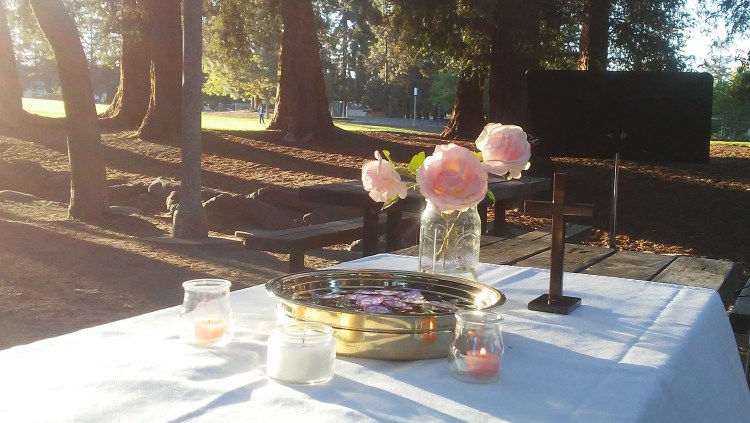
In September 2014, I noticed a local park near my church that was very busy and diverse. It was surrounded by apartment complexes, but I did not know anyone in those facilities or that community. I went home asking the Lord to give me this park for His Kingdom. I worried about looking suspicious showing up in a park on a weekday morning without a child or a dog to accompany me, since most park visitors are either dog walkers, caregivers of young children, or senior citizens. As I considered that I was engaging in a spiritual battle, I remembered the story of Jericho’s walls tumbling down after seven days of prayer, so I began a seven-day prayer walk in the park.
Outreach Began With Prayers
Every morning I went to pray and walk around the park several times, in order for the residents of the park community to grow accustomed to seeing me there. On the seventh day, God led a Burmese Chinese lady, Auntie Siu, to me. Auntie Siu walked up to me and asked, “Are you Chinese? You are new here.” After chatting with her for a while, I learned that she was a permanent resident who knew most of the Chinese seniors in the park. Through her introduction, I began to become acquainted with other Chinese people. Through my inclusion in the Chinese group, and the consistency of seeing me on a daily basis, other park visitors began to converse with me, including elderly people and caregivers for young children. Most of these people had no means of transportation to attend any community activities, and they measured distance by walking time. Gradually, I learned about their interest in toddler storytime and adult ESL classes.
Toddler Storytime
I had no familiarity with the concept of “storytime,” because I grew up in Asia and have not raised children here. In order to meet this need, I went to two local libraries to observe how they run their storytime, and searched online to learn how to design a storytime program. I noticed that most non-American toddlers who did not speak English at home could not understand stories in English and would wander around in the libraries, but they loved singing. Using my love of music and dancing, I took several renowned ethnic songs and designed moves for children modified from YouTube video clips for my storytime. As a diaspora, I know what it means to hear songs from my home in a foreign land. One year after that 7-day prayer walk, God led me to begin my park outreach ministry.
In October 2015, I held the first free storytime with a complimentary breakfast at my church and sent out 35 invitations. I thought I had built enough relationships to invite non-Christians from the park to come to my church, but only five toddlers showed up that day with their caregivers. Later I heard from other caregivers that they did not believe it would be free, and worried that people from the church would proselytize to them. However, the caregivers who did attend went back to the park and shared their experience with the others, so the second storytime doubled in size. By the third storytime, attendance had tripled!
Within a few months, attendance began to decrease again. I learned that most families in the Silicon Valley send their toddlers to daycare once they are two years old. Once the children are sent to daycare, their caregivers stop coming to the park because the nannies find new employers and grandparents’ help is less needed. All the relationships that I had spent a lot of time building quickly disappeared. By the end of that year, attendance went down to single digits, and I could not invite any new families because they did not know me. Therefore, I moved the location from church to the park in January 2017. Doing storytime outdoors has some limitations, but it gives the attendees freedom to come and go as they please.
From October 2015 to the end of 2019, the storytime outreach served a total of 585 adults and 599 toddlers from 18 ethnicities. The majority of attendees during the first three years were Chinese, but the attendees have diversified since 2019.
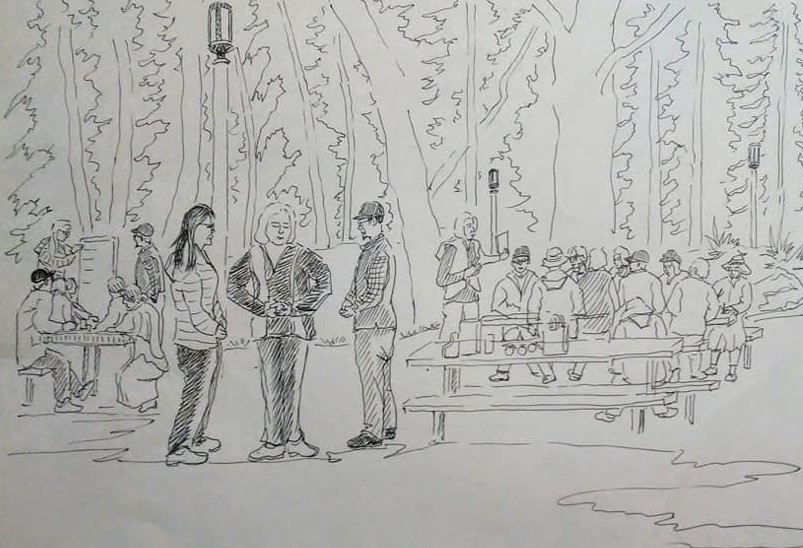
ESL Classes
After I started storytime at my church in late 2015, Auntie Siu kept telling me her wish to learn some English. On a weekday morning in March 2016, I brought a coffee pot and some foam cups to the park and then invited the Chinese seniors there to come to the picnic table area for a functional ESL class. Five people came for the first ESL class, and the attendance increased afterwards. When the summer began, I noticed a small group of South Asian seniors who came to the park regularly. When I asked if they were Indians, they said they were Nepalis. I was overjoyed to meet Nepalis here since I had heard about the country from my father growing up. I went home and used Google translation to translate free ESL flyers in Nepali for them. But when I tried to distribute them, one of the men shook his head and threw it back at me after reading it. It was very humbling to be rejected when your heart is full of love and a willingness to serve. Isn’t that how Jesus feels when His love is rejected by the unsaved? I am sure it hurts Him much more than it hurts me. I did not give up on the Nepalis God brought to me, and continued praying for opportunities to get to know them.
One morning I saw a Nepali woman sitting alone at a nearby picnic table as I walked to the parking lot after leading an ESL class. I knew that I should go and talk with her, but I was tired from teaching and passed her by. After returning home, I regretted not taking the opportunity God had put in front of me. I repented and asked the Lord to give me another opportunity. I did not see her again immediately, but I kept praying. Two weeks later, the Nepali woman showed up.
I walked up to her with a big smile and pointed at myself to tell her my name. She quickly pointed to herself and told me her name is Siva. When I asked how she was doing, she waved her hands at me to indicate that she could not understand English. Since I did not know a word of Nepali, I quickly raised my right hand and taught her to count from one to five. She left with a big smile. The next time when she returned, she brought her husband and three other Nepalis with her. By August 2016, there were fourteen Nepali people in the third Nepali ESL class.
I have learned that there are very few free programs for many of these elderly residents; therefore, I must prove to them that these classes and services are free, with no strings attached. God gave me this precious opportunity to learn how to reach diasporas through love and friendship, in spite of the language barrier. There were two Nepalis who volunteered to interpret for me when they were available. When I shared my dimple testimony to these seniors on my birthday, they could relate to my story because of our similar male dominated cultures.
I have also learned that Nepalis are even more relational than Chinese and Indian groups who come from similar backgrounds rooted in group culture. Once I am accepted by a group member, I am accepted by the whole group. Some of my elderly Nepali friends wept before returning to Nepal, saying I had loved them more than their adult children had. Because of the high cost of living in the park community, most of the Nepalis I knew later purchased their first house at a more affordable price and relocated to the northern San Francisco Bay Area, which is a two hour drive from the park. Siva returned to Nepal and decided not to come back to the U.S., but her husband, Nan, stayed here. Once again, I lost friends with whom I had spent a lot of time. However, nothing is wasted because I have done what God has put in front of me by serving them when they were with me. I trust them to God and believe that He will lead some other Christians into their paths.
From March 2016 to the end of 2019, these two ESL classes served a total of 335 people⸻244 Chinese, 87 Nepalis, and 4 of other ethnic origin.
Serving a Japanese Homeless Man
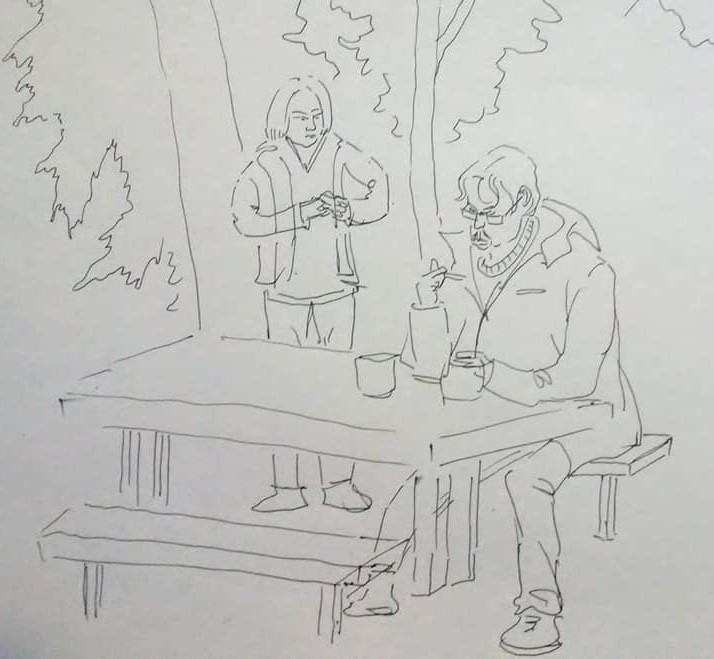
One day after the Nepali ESL class, Raa, a volunteer Nepali ESL class interpreter, asked to meet me on the following Saturday morning in the park. It was a cold and sunny early November morning of 2017, and the temperature was in the 30s. Raa and I walked around the park to keep ourselves warm while she shared her story and family matters with me. When I looked at the area where we hold our weekly ESL classes, I saw an Asian man with glasses sitting on the bench and facing the sun. The thighs of his blue jeans were torn with two big holes. The second time Raa and I walked near him, it looked like he was trying to defrost in the sunlight and keep himself warm. I felt so sorry for him and said to myself, “This poor man is created in the image of God but cannot keep up the image decently.” After meeting with Raa, I left the park fully loaded with all her concerns on my heart. Because my room has no central heat, that evening I was shivering in spite of my portable heater fan.
Suddenly, I heard God asked me, “Are you cold?” and I said, “Yes, but I am thankful to have a roof over my head.” Then God asked me, “What about the man you saw in the park this morning?” The image of that man sitting in the sun with two big holes in his jeans came to my mind vividly. I knew what God was trying to tell me, but I tried to get away from it because I had been stretching my already very limited financial resources to cover my study, ministry, and living expenses. I said to God, “He is not the type of person I am trying to reach in this park outreach.” God said to me, “If you are reaching out in the park and he showed up there, you need to reach out to him. It is not up to you to decide who should be reached.”
The next morning before I went to church, I prayed and asked the Lord to help me find the man in the park so I could give him a bowl of hot noodle soup and some coffee. I was very happy to see him sitting in the same area where I had seen him the day before. To my surprise, he would not lift up his eyes to look at me and accept the food I had prepared for him. I tried to converse with him by asking his ethnicity, and I learned that he was Japanese. Thank God for the two years of Japanese lessons I had taken many years ago, even though I had forgotten most of them! Speaking with him in his mother tongue helped him to relax and accept the food. His name is Toshi, and he came from northern Japan to study at the community college where I was involved in the foreign student ministry few years earlier. He said he still had one year to finish his studies. Before I left for church, I told him that I would bring him food the next Sunday.
When we met again, I brought a measuring tape in order to buy Toshi a pair of trousers and a belt from a thrift store. Once again, he would not lift up his eyes to look at me when I tried to talk with him. But soon after I told him that my sister got her PhD from a Japanese national university, he looked at me and said he got his bachelor’s degree from one of the nine national universities as well. Toshi’s heart opened and he began to converse and treat me as a friend. This might be the first time I have ever been so thankful for my dear sister! I told Toshi that I would share with him whatever I ate in spite of my limited financial ability. From then on, we began to meet in the park on a regular basis.
Through my father’s and sister’s Japanese educational background, I learned that the concept of honor and shame is even bigger in Japan than it is in Taiwan. Therefore, it is rare to see a homeless Japanese person. After meeting with Toshi several times, I suspected that he must have suffered from some type of trauma, because sometimes his story did not add up to me. I contacted the Japanese Consulate in San Francisco to find out if they could help Toshi return to Japan, but they would only assist if he wanted to go back. One day, several of the elderly Chinese residents told me what they knew about Toshi, I was finally able to put it all together.
Toshi had been roaming around the park community for nearly eight years. He came to study computer animation with half of his finances provided by his father, a construction worker, and half provided from his own savings from previous work. After coming to the U.S., Toshi indulged in gambling, and later he lost all his money. His father was furious and ashamed of him, so he told Toshi not to return to Japan and that he might as well die in the U.S. Without a working visa, Toshi could not work legally in the U.S. and could not be independent. After hearing the story and learning that Toshi had work experience and had been here for nearly eight years, suddenly I recalled meeting an older Asian man in a new student welcome reception eight years ago.
Most foreign students I have met are in their late teens without work experience. But I remembered this Asian man with glasses walking up to me during the welcome reception. He had told me that he was different from other students because he had work experience before he came over to study. I could still remember the height and image of that student, and now I am pretty sure it was Toshi that I met. My heart was saddened because he had been right in front of me eight years ago. How I wished that I would have paid extra attention to him to prevent what happened to him later. Toshi will always be a reminder to me that I should not pass any opportunity by.
It has been more than two years since I began reaching out to Toshi. Thanks to a local community homeless service, he does not lack for food. But I still bring him food and coffee once a week, to chat and pray with him as a friend with whom he is willing to make eye contact. I know Toshi is not forgotten because Jesus loves and cares for him. Whenever I had difficulties in caring for Toshi, God would provide; not to mention how often He reminds me not to hoard my food and share it with Toshi! Others from the park outreach often praise me for my care for Toshi, although helping him in public was not my intention. God uses my help to prepare the hearts of other non-believers to feel and hear His love for them.
Special Family Events
I teamed up with Christian friends from different local churches to host Easter services followed by egg hunt, summer family nights, and Christmas music events with dancing, singing, and group games as opportunities to share the Gospel and build relationships with the families of those who had attended the park outreach activities. Some of the Indian and Nepali attendees told us that this was the first outdoor music event they had ever attended. Toshi was invited as well.
In the summer of 2018 and 2019, I held park worship services. Worshipping God in a public place allows non-Christians who have never stepped into a church to see and experience what it is like to worship the Triune God. This is part of the behaving step to be a Christian from St. Patrick’s outreach model by acting like a Christian to engage in conversation, ministry, prayer, and worship within the group.
It was a challenge for the team to prepare a Gospel message without an interpreter available. By the grace of God, we were able to have the messages translated in Nepali before our meeting and have them printed out with Nepali Bible verses and lyrics. I learned to sing two Christian songs in English, Mandarin, and Nepali. Nan was a regular worship attendee, and he would earnestly read the Nepali print out we prepared for him as soon he arrived. Once we even had a Nepali family who had just arrived in the U.S. a few days earlier join our worship.
English Bible Study
All of the outreach activities always begin and end with prayers. Now the outreach attendees have become so used to being prayed for that any time the team is in a rush and forgets to end an activity with prayer, the Chinese ESL students will remind us not to dismiss the class until we have prayed! In the summer of 2019, for several weeks straight, I had people ask for a copy of the Bible. Sensing this was the work of the Spirit, I talked and prayed with Amy, another ESL teacher, to consider launching an English Bible Study after her ESL class. Amy had been hoping to teach the Bible in her class, but I had asked her to wait. Now the time for her to teach Bible Study had finally come, after two years of waiting!
Amy lets her students choose to leave after English class or stay for Bible study, and most of them choose to stay. With her excellent teaching skills and established trust and relationships, she is very much loved by her ESL students. Amy takes on the challenge to teach the Bible to elderly ESL students by preparing her Bible verses in different languages to make sure her students understand the meaning correctly. Amy joined me in September 2017, and I am very blessed to have her. Besides her gifts, I have learned so much from her adaptability, cooperation, humility, servanthood, Kingdom mindset, love for God and others, submissive spirit, and Spirit-transformed life. Through her, I have also learned the major qualifications to look for in a teammate.
Chinese Exercise Class 拍打功
Daniel, a pastor of a nearby Chinese church, joined the outreach team in September 2018. After exploring how best to use his time and skills to serve the park community, he started teaching a Chinese exercise class every other Friday morning, beginning in the summer of 2019. God has used this class for us to serve Chinese and non-Chinese seniors who are interested in exercising. Once Daniel walked up to me after his class and said, “Your Kingdom vision is correct. Multi-ethnic outreach should be for the Kingdom expansion, not for our own church growth.” Knowing that he was very busy with his church ministry, I told Daniel it would be all right to discontinue the class if necessary. Within few seconds, he looked at me and said, “I love these people, and I am reluctant to lose them.” Our love for God and others has led Amy, Daniel, and I to work together for the Kingdom.
Volunteers and Teammates
I use these outreach activities to group people together as the first step of belonging, according to St. Patrick’s model. The outreach is holistic and pre-evangelistic. Its intent is to provide a platform for ethnic Christians and ministers to build trust and relationships with non-Christians of the same and different ethnicity within the same group. The outreach team uses our anniversaries, birthdays, and holidays as opportunities to share our testimonies. We are to be creative in sharing the Gospel naturally, without lecturing or nagging people. The second step of the model is for non-believers to have the opportunity to learn how to behave like a Christian in the group to practice lifestyle. And then when the time comes, they will believe Jesus is their Lord as the third step. These three steps take time to develop with patience and perseverance.
Criticisms and Functionalism
When I started the park outreach, twice I sent an email to every church near the park, inviting them to join me, but none of those churches chose to partner with me. I received unsolicited criticism for not sharing the Gospel or being a lone ranger in my park outreach, often from those who did not understand the outreach model and the difficulty of engaging local churches in the ministry. Because we are all influenced by functionalism and the traditional outreach approach, it takes training and a lot of modeling to help volunteers fully comprehend St. Patrick’s model. Since I did not have spare time to train any new helpers while I was doing my doctoral study, volunteer recruitment and training was frozen. Thankfully, I have several bi-cultural friends and trainees from my experimental training to help out with special outreach events after they got off from their full-time jobs. They have been willing to serve any number of people God would bring to us, and have been a great encouragement to me.
The Silicon Valley’s engineer mentality and highly programmatic and managerial culture heavily influence our missional approach. Unsolicited criticism include some Christians could not believe that I would hold outreach in a park instead of inside a church building! Some said the outreach was unstructured, and some were disappointed when outreach activities had low attendance. Keeping my eyes on untrained volunteers can drain my attention and energy because any mistakes from their contradictory approach could erode the trust and relationships that took me years to build.
More than once, an elderly Anglo sister yelled at me and asked when I was going to share the Gospel, after hosting storytime several times at our church. A Chinese sister challenged me for not sharing the Gospel in the weekly park outreach gatherings. Even after I explained St. Patrick’s pre-evangelistic missional approach to her, the next time she came to the park she distributed Chinese Gospel tracts to every Chinese attendee without letting me know ahead of time. Because of the attitude of these two sisters, I had to ask them to stop coming. Once a local Chinese pastor came for a visit and then said that providing transportation for the elderly park residents to get to his church would be a huge task. Another Chinese pastor said it is a waste of time and resources to allow non-Christians to take advantage of free activities, and we should focus only on discipling those who are responsive to the Gospel. I have also learned that accountability is an issue that needs to be addressed, because there were ministers using my outreach to raise their own financial support.
Reflection
It is a miracle that this park outreach has been able to carry on with very limited resources and only three people on the regular outreach team because the One who calls me is faithful for His Kingdom. My conversion experience of spiritual attack and healing has become a great testimony to share the Gospel with Indians and Nepalis who are looking for power to set them free from fear. I am fully aware that I am involved in a spiritual battle. Several times when my team was too busy to pray before the activities began, I saw toddlers were absent minded and wandering around, or someone in the park came to disturb us.
After taking the diaspora missiology course from Dr. Enoch Wan at Western Seminary, I came to understand how God has prepared me for the diaspora/glocal missions we are facing right now. Psalm 139:16 says, “You saw me before I was born. Every day of my life was recorded in your book. Every moment was laid out before a single day had passed.” I came to America as an unbelieving diaspora and accepted the Lord two years later, serving in a Chinese mission organization for global missions, returning to my homeland to serve among my countrymen and foreign prisoners, and now I am reaching out to the multi-ethnic people of the community and training outreach workers.
I know what it is like to be a diaspora, and how difficult it is to convert a diaspora. Relationships and trust are very important to reach group culture diasporas. It takes time for a diaspora to believe in Jesus. God brings diasporas to our community so they would be like me: being away from my family was a way to sanctify me, and to set me apart from my family religion that is deeply rooted in our daily way of life. I grasp the opportunities God puts before me, learning to multi-task and become adaptable. I have to learn from my mistakes and they are many. Intercultural outreach training has helped me tremendously, but most important is having the Christlike character to be the right person as a witness.
Our park outreach is fluid, as people come and go as they please or need to, and we might not see immediate results. We should not drop relationships when the Gospel is rejected. We are called to faithfully serve the multi-ethnic community and continue witnessing. We must be sowers, perhaps the first sowers these people have come into contact with, and trust that God will bring other sowers into their paths. In 2019, several Chinese seniors accepted Christ through their adult Christian children or Christian friends. Mrs. Hong was baptized in November before she returned to China. She told us that she has been visiting the U.S. every six months for seven years already. Through those years of visits, she has heard about the Gospel through her son, the park ESL class, and other Christian friends, and it took her seven years to make the decision. The outreach team rejoices with these new believers. It is our goal to commission new believers to be evangelists to their kinsmen wherever they go.
 Relational Realism for Christian Ministry 關係論與基督教事工